A Guest Room for One Night: Set Up the Welcome
A guest room for one night feels welcoming when belongings have a clear place and the room’s small routines are easy to understand.
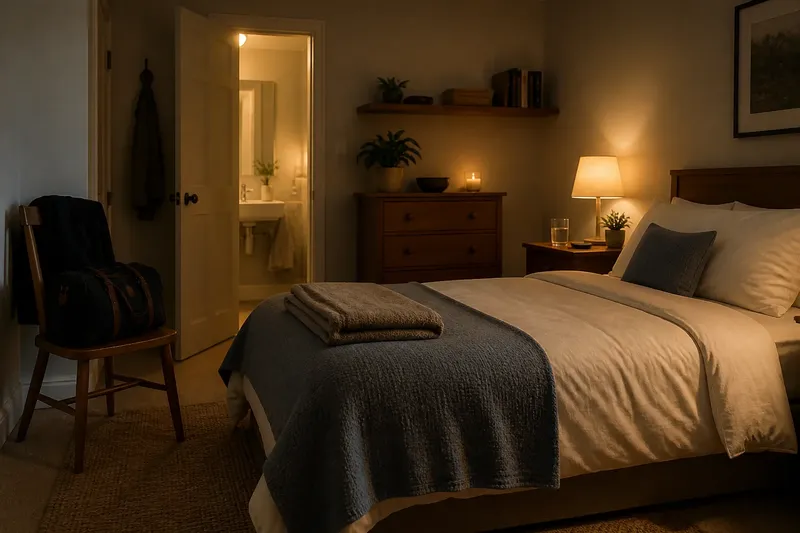
Your guest arrives with a coat over one arm and a small overnight bag in the other. You show them the spare room, then realise there is nowhere obvious to put either. Preparing a guest room for one night means answering a few practical questions: where belongings go, how the room works, and what to do if a small need arises.
Keep the preparation proportionate. A chair, a clear surface and a short explanation can make an unfamiliar room easier to use than a collection of decorative extras. These choices help your guest settle without turning the evening into a tour of the whole house.
1. Clear one useful landing place
Choose a surface near the bed or entrance where a guest can put a phone, glasses, book or water glass. A bedside table is useful, but a sturdy shelf or the uncluttered corner of a chest of drawers can work just as well. Remove household paperwork, spare chargers and items that belong elsewhere.
Leave enough of the surface open that it reads as available. A small lamp can stay if its switch is easy to reach; a stack of objects that must be moved first sends a less clear message. If the room has no bedside furniture, an empty chair can hold a bag while the floor remains clear for walking.
Say where the guest can leave anything that does not fit. A simple “You can put your bag on that chair” is more useful than an explanation of every drawer.
2. Make the bed easy to understand
Fresh sheets are the obvious starting point, but the bed should also be simple to adjust. Set out a spare blanket where it can be seen, such as folded at the foot of the bed or on a nearby shelf. The guest can then choose whether to use it without needing to ask.
Check that the pillow and duvet are arranged as you intend them to be used. If there is a choice of pillow, leave the spare within reach rather than stored behind other bedding. A clear route from the bed to the door matters too; move laundry baskets, shoes and loose cables out of the way.
Imagine a narrow spare room where the only chair is beside the bed. You clear it, place the extra blanket at the foot of the bed, and show the guest where the light switch is. They can then set down a bag, adjust their bedding and settle without moving household clutter.
3. Give clothes and bags a proper place
A guest may bring only a small bag, yet still need somewhere to open it. Keep a section of floor clear or leave the chair available for a coat and folded clothes. If the room has a wardrobe, clear a small portion of the rail and a hanger or two; do not assume the guest will want to unpack fully for one night.
For a room without a wardrobe, hooks on the back of the door can hold a coat or day bag, provided the door still opens freely. A luggage rack is handy if you already own one, but it is not essential. The useful question is whether the guest can reach their belongings without shifting your things.
Make the available space apparent. A brief offer such as “There’s room for your bag on the chair” removes guesswork and avoids the awkwardness of a guest trying drawers that are full.
4. Explain the room’s small controls
Point out the light switches, curtains and any fan or heater the guest may reasonably need to use. Keep the explanation brief and specific: which switch turns on the bedside lamp, whether the curtains pull from the centre, and where the room’s ordinary controls are. If an appliance is unfamiliar or its operation is not obvious, it is better to leave it off than to invite guesswork.
Show how the door closes and whether it locks, if there is a lock. Mention any ordinary household sound that might otherwise be puzzling, such as a boiler starting or a hallway light controlled from another switch. Focus on what a guest might need while alone in the room, rather than listing every device in the house.
Where an appliance or fitting depends on its label, manufacturer instructions or local rules, follow that guidance rather than improvising. For anything involving a safety concern, give a simple alternative, such as using another room or asking you for help.
5. Make the route to the bathroom obvious
A guest who knows the bathroom is nearby may still hesitate over which door to use at night. Point out the route on arrival, and make sure the path is not blocked by shoes, folded laundry or a bag. If the bathroom is shared, say whether the guest can use the towels already set out and where to find a fresh one if needed.
Leave a hand towel within easy reach and make the soap visible. If the bathroom has a light switch outside the door or a confusing layout, mention it once. These directions are particularly useful in a dim hallway, where a guest may not want to explore by opening several doors.
Keep the explanation calm and matter-of-fact. The aim is to make the route clear, not to apologise for the room or narrate the household’s entire routine.
6. Set out only the essentials
A glass of water, a clean towel and a visible place for a phone charger can cover common needs without crowding the bedside table. If you offer a charger, check that it suits the guest’s device before presenting it as useful. Otherwise, mention where a spare socket is, if it is easy to identify and safe to use.
Do not fill the room with toiletries or snacks the guest has not asked for. A short spoken offer can point to where drinking water is available and how to ask for anything else. If the guest has mentioned a particular need, respond to that rather than guessing at a set of extras.
Keep personal items out of sight and leave the guest’s immediate space uncluttered. The welcome comes from making choices available, not from filling every empty surface.
7. Tell them how to ask for help
A guest should know whether you are going to bed, where you will be, and how to get your attention if they need something. A simple sentence is enough: “I’ll be in the back room; knock if you need me.” If you prefer not to be disturbed after a certain point, explain that gently and say what the guest can do for ordinary needs, such as finding water in the kitchen.
Offer information that affects the guest’s comfort rather than a full set of household rules. For example, explain whether they should leave the bedroom door open or closed if that matters in your home, and whether the hallway light can be left on. Keep any request clear and reasonable.
That small exchange gives the guest a way to resolve uncertainty without feeling obliged to manage the household on their own.
8. Check the welcome from the doorway
Before your guest arrives, stand at the entrance to the room and look at what is immediately visible. Can you tell where to put a bag? Is the bed ready? Can you see the route to the door and the main light switch? This quick check catches practical omissions that disappear from view when you are familiar with the room.
Then make one short pass through the room: remove anything you would not want a guest to move, place clean bedding and towels, and make the useful controls and belongings space apparent. Avoid a last-minute rearrangement that makes the room less familiar to you and harder to explain.
A guest room for one night does not need to imitate a hotel. It needs to let someone arrive, put their things down, understand the basics and rest. Give those needs a clear place, and leave the rest of the room alone.