Before the Laundry Basket: A Short History of the Clothes Peg
The clothes peg’s history traces two distinct designs, from split wooden bodies to hinged springs, and explains what each reveals about hanging washing.
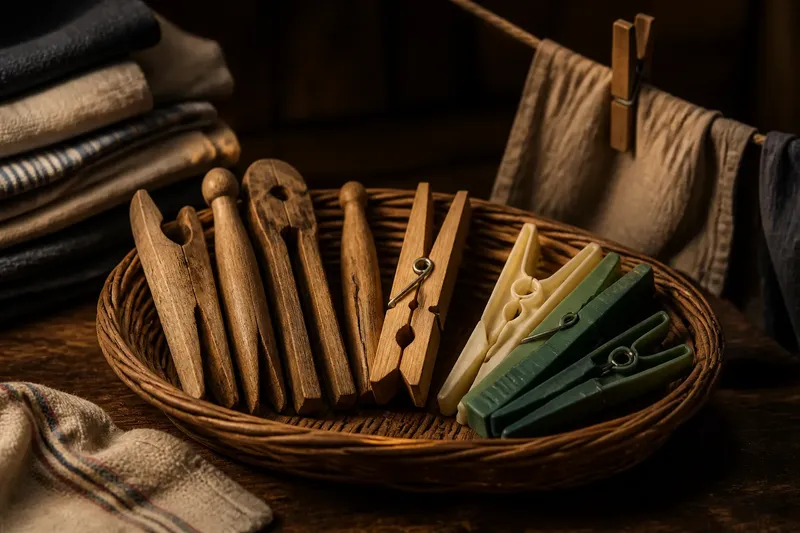
A wooden clothes peg clicks against the line as a damp sleeve lifts in the breeze. The clothes peg’s history can be read in that brief movement: a small object holding cloth in place, its shape altered over time to make the job easier to do.
Early pegs took different forms
There is no single, well-documented starting point for the clothes peg in ordinary household use. Before hinged pegs became familiar, people used simple ways to keep fabric from slipping while it aired. Accounts and surviving examples vary, so it is safer to describe the older forms as a family of practical solutions than to give them one origin story.
Some traditional pegs were carved from a single piece of wood. A split or forked end could press fabric against a line, with the wood’s own flex providing the grip. Other forms were shaped to straddle a line or hold cloth at an edge. Their outlines depended on the maker, available material and the support used for drying.
These objects were direct in purpose. The peg needed to be small enough to handle, firm enough to keep cloth from shifting, and shaped so it could be removed without a complicated action. Its modest design responded to an everyday task rather than a single standard pattern.
A split wooden body made its own spring
In a one-piece wooden peg, the material does the work of a mechanism. A cut divides part of the body into arms that can flex as the user grips them. This keeps the construction simple, but the feel depends on the wood and the condition of the split.
Wood is light and easy to shape. A smooth body can sit comfortably in the fingers, while a narrow end can reach a fold or seam. Yet wood may swell, dry, split or wear. When the arms become stiff or uneven, the peg can be harder to open or less dependable on the line.
There was no single ideal profile. A forked head, a notch or a divided end could all serve the same broad purpose. What mattered was how the peg met the cloth and the drying support.
The hinged peg gave the spring a separate job
The familiar spring peg uses two jaws joined by a metal coil. Squeezing the handles opens the jaws; releasing them lets the spring close them around cloth and line. The design separates the user’s grip from the force that holds the garment.
That arrangement makes opening and closing a clear, repeatable action. It also introduces more parts. A spring can corrode or loosen, and residue can gather around the joint. The hinged peg is not simply a later improvement in every respect: it offers a different balance between ease of operation and mechanical complexity.
The change is best understood as a design milestone, not as a claim that every household moved from one form to another at the same time. Both one-piece and hinged pegs illustrate different ways of solving the same small problem: how to hold fabric on a line and release it by hand.
Material changed the peg’s feel and care
Wood, metal and plastic each affect the contact between peg and fabric. Smooth wooden jaws can be gentle, though a splinter or rough grain may catch a fine weave. Metal can be firm and slender, but corroded or dirty surfaces may mark damp cloth. Plastic allows varied shapes and rounded grips, yet a cracked body or worn joint can weaken its hold.
Rather than choosing by material alone, look at the working surfaces. Check that the jaws meet evenly, feel smooth against a fingertip and open without sticking. If a peg has sharp edges, a split body or a loose spring, set it aside.
Choose a peg for the fabric and support
A peg meets three things at once: the cloth, the line and the hand. Wide jaws spread contact across more fabric; narrow jaws fit into a small fold but can press more sharply. Rounded edges are less likely to catch a loose thread. The support matters too: a peg made for a thin cord may sit awkwardly on a thicker drying-rack bar.
Imagine you have lightweight cotton tops and a narrow balcony line. You sort out pegs with smooth, moderate-width jaws, then attach them at sturdy seams rather than across delicate front panels. You leave space between the tops instead of crowding them together. The expected result is a secure hold with less bunching; if a peg cannot close around the line, you choose another whose jaws fit the support.
Keep the working pile simple: remove any peg that snags fabric, fails to close or slips on the line.
What readers ask about clothes peg history?
What is the difference between a one-piece peg and a spring peg?
A one-piece wooden peg flexes through its own split body. A spring peg uses two jaws and a separate coil to open and close around the line.
Why did the hinged design matter?
It gave the user a distinct handle to pinch and assigned the gripping force to a separate spring. That made the action familiar, while adding a joint that could wear or corrode.
Are wooden pegs kinder to clothes?
They can be gentle when their jaws are smooth, but wood is not automatically safer for every fabric. Check for splinters, rough edges and uneven contact before using one on delicate cloth.
How should I choose a peg for an indoor drying rack?
Check that the jaws close around the rack’s bars and that the peg does not crowd neighbouring garments. If it sits loosely or awkwardly, choose a shape suited to that support.
The peg’s history remains visible in its mechanism
The clothes peg’s history is clearest in the contrast between the split wooden body and the hinged spring design. One relies on a single material to flex; the other gives that work to a coil. Neither shape tells the whole story of household laundry, but together they show how a small tool can be adjusted without changing its basic task.
When you choose pegs, inspect the point where they meet the cloth and the line. A smooth contact surface and a mechanism that opens and closes cleanly are more useful than a matching set. The best fit is the peg that holds the particular fabric on the particular support without snagging or slipping.