The Tidy Countertop Myth: What Belongs Within Reach?
What belongs within reach on a countertop? Keep visible items that support a repeated task, so useful tools are close without letting clutter take over.
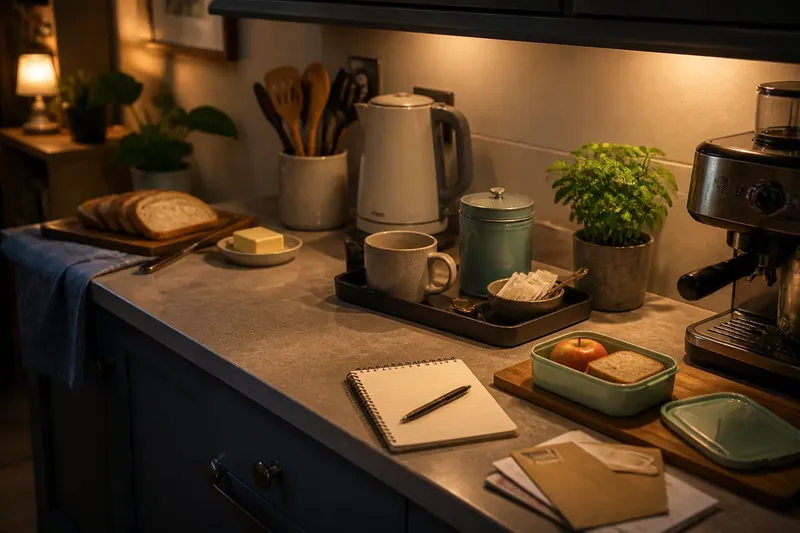
You make tea, reach for the tin, and find it behind a row of appliances pushed back to keep the counter clear. The neat surface has made a familiar task slower. Deciding what belongs within reach on a countertop starts with the work you do there, not with the number of objects you can hide.
A counter is useful space, but it is also a working surface. The aim is neither to display everything nor to clear everything away. It is to give repeated tasks a convenient home while keeping enough room for the next thing you need to do.
Start with one repeated task
Choose a task that regularly brings you to the counter: making breakfast, preparing coffee, packing lunches, or sorting the post. Avoid trying to redesign the whole kitchen at once. A single routine gives you a clear way to judge whether an item earns its place.
Think through the task from its first action to its last. For making coffee, that might mean taking out the mug, filling the kettle, measuring coffee, and putting used items away. Notice what you reach for, where you set things down, and which cupboards interrupt the sequence.
Say you make tea each morning and often leave the tea tin and teaspoons on the counter. If reaching for them is part of the same small routine, keeping them together may make sense. A decorative jar you rarely use may not serve that task, even if it looks at home beside them.
Write the task in a few words if several routines compete for the same stretch of counter. “Make coffee” is more useful than “keep kitchen tidy”: it points to particular objects and actions.
Watch where the task actually happens
For a few ordinary occasions, pay attention to where each part of the routine takes place. You do not need to record every movement. Notice the tools you fetch repeatedly, the items that travel between rooms, and the surfaces that become temporary landing places.
The counter nearest the kettle may be right for mugs and tea, while a chopping board belongs near the area where you prepare food. An item can be useful in the kitchen and still be awkward on a particular counter. Reach should be judged from the task’s natural starting point, not from the room’s most visible surface.
Also notice whether an object is genuinely used or simply left there. A letter opener beside the post pile may support a regular sorting habit. A screwdriver left beside it because it had no other home is serving storage, not the post routine.
Keep the observation ordinary. There is no need to stage the task or move things before you understand how you use them.
Sort objects by what they do
Gather the items connected to your chosen task, then sort them into a few practical groups:
- Used each time: the mug, spoon, or other tool you reach for as part of the routine.
- Used at a nearby stage: an item needed only when you prepare, finish, or clear up.
- Occasional: something useful for a less frequent variation of the task.
- Unrelated: an object that has arrived on the counter but does not help with this routine.
The first group is the strongest candidate for a place within reach. The second may belong nearby, in a drawer or cupboard that does not break the sequence. Occasional items need not occupy the easiest space all the time. Unrelated objects should be considered on their own, rather than being granted a place simply because they are already there.
Use the job an object performs, not its appearance or category, as the deciding factor. A small tray can keep tea bags and teaspoons together, but it is useful only if it makes the task easier to carry out or clear away.
Choose a place that supports the sequence
Place the items you use each time near the point where the task begins or where you need them. Keep companions together if doing so makes one action simpler: a coffee scoop beside the coffee tin, for example, rather than scattered across the counter. Give each item a defined place, so it does not spread into the space needed for preparation.
Not every useful item needs to sit in open view. A shallow drawer, a wall hook, a cupboard shelf, or a small container may keep something accessible without claiming the work surface. Choose the location that matches how you retrieve and return it. A tool used mid-task may be better in a nearby drawer than behind the appliance you use first.
Leave a clear patch where the task needs it. That might be the space for a chopping board, a lunchbox, or a mug while the kettle boils. A counter can hold a few purposeful objects and still provide a place to work; clearing every inch is not the only way to preserve usable space.
For objects with specific handling or placement requirements, follow the relevant product instructions or local guidance.
Make a small trial and adjust
Try the arrangement during the routine itself. Notice whether you can reach each useful item without moving something else, whether the task has a comfortable place to happen, and whether putting things away feels natural. These are observable signs that the arrangement fits the work.
Imagine someone who makes toast and packs a lunch at the same counter. They move the bread bin and butter to a nearby shelf, keep the lunchbox in a cupboard close to the preparation area, and leave the board space open. The expected visible result is fewer objects in the way during packing, while the items used for breakfast remain easy to reach.
If an item repeatedly goes unused, give it a less prominent home. If you keep fetching the same tool from a cupboard, consider moving it closer. Change one placement at a time where possible; that makes it easier to see which change helps and avoids replacing one jumble with another.
Do not let a successful arrangement become a rule that every household member must follow without discussion. A shared counter may serve people with different routines. Agree on a few fixed homes for common tools, and leave a workable patch for tasks that vary from person to person.
How should you decide what stays visible?
Should every daily-use item stay on the counter?
No. An item may be used daily yet fit better in a nearby drawer, especially if it occupies space needed for preparation. Keep it within easy reach if fetching it from elsewhere disrupts the task.
What if one counter serves several routines?
Start with the routines that happen most often or need the same tools, then place shared items where both tasks can reach them. Keep less frequent or specialised tools in a nearby cupboard rather than giving every routine a permanent patch of counter.
How can you tell whether an item is only clutter?
Ask what repeated action it supports and whether you would notice if it were stored elsewhere. If it has no clear role in the task, try giving it another home and see whether the routine becomes harder to complete.
What if the counter still feels crowded?
Look first at items that belong to occasional tasks, then consider whether a tray or container is taking more room than the objects it organises. Move one group at a time so the surface can remain workable while you refine its arrangement.
Keep the arrangement tied to the routine
Once the layout feels workable, return items to their homes as part of finishing the task. That small habit helps preserve both access and a clear place to work. If the routine changes, reconsider the arrangement rather than defending a setup that no longer fits.
The tidy countertop myth is the belief that an empty surface must be the most useful one. What belongs within reach on a countertop is whatever supports a repeated task in that particular home, without blocking the next action. Let the routine make the decision, and keep the counter clear where hands need room.